


Companies registered in the UAE benefit from a number of advantages, including a favorable business environment, advanced infrastructure, a stable banking system, and ease of conducting international business. At the same time, the costs of company formation in Dubai and other emirates may vary significantly depending on the chosen structure, license type, and business objectives.
Before deciding to establish a company in the UAE, it is important to understand which business format is required and the associated costs. Below are the most common business setup options and indicative costs applicable in 2026.
Option No. 1 – international business outside the UAE
This format is suitable for companies conducting business exclusively outside the UAE. In this case, only a registered company and a corporate bank account are required. There is no need for a physical office or a UAE residency visa.
The most cost-effective solution for this model is to register an offshore RAK ICC company in the Emirate of Ras Al Khaimah. Approximate costs for registration and maintenance start from AED 7,500 (≈ USD 2,040) in the first year, depending on the selected package and registered agent. From the second year onward, annual costs typically range from AED 4,500 to AED 7,500 (≈ USD 1,225–2,040), including government fees and basic administration.
RAK ICC offshore companies are not subject to mandatory audit requirements and are not required to maintain accounting records in the UAE. The registration process is simple and fast, and ongoing management and administrative requirements are minimal.
Option No. 2 – international business both outside and within the UAE
This option is suitable for companies operating both internationally and within the UAE, without the need for a physical office in Dubai. The only requirement for conducting business inside and outside the UAE and for obtaining a residency visa is the existence of a registered legal entity.
The optimal solution in this case is to establish an onshore company in one of the UAE free economic zones using a virtual office or flexi-desk arrangement. Such companies can be registered in various free zones across the Emirates and allow the business owner to obtain a residency visa with the appropriate package.
The indicative cost of a full registration package, including the trade license, virtual office, and residency visa, typically ranges from approximately AED 30,000 to AED 50,000+ (≈ USD 8,000–13,500+) for the first year, depending on the selected free zone, license type, and additional services.
Option No. 3 – international business with physical presence and a real office in the UAE
This option involves the same conditions as Option No. 2: the company may operate both internationally and within the UAE and may obtain residency visas for owners and employees. The key difference is the requirement to lease a physical office rather than use a virtual one.
In this case, office rental costs are added to the basic expenses associated with free zone company registration.
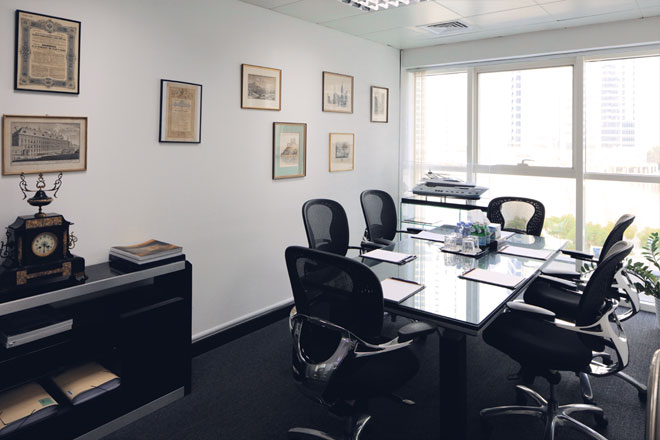
As of 2026, the average annual rental cost for a minimally required office space of approximately 50-60 square meters in a good business district of Dubai ranges from AED 55,000 to AED 70,000 (approximately USD 15,000–19,000). The final amount depends on location, building class, included services, and lease terms.
Having a physical office allows companies to:
- increase the number of available residency visas;
- simplify cooperation with banks and business partners;
- enhance business credibility when dealing with local partners and government authorities.
This option is suitable for companies that require a physical presence in Dubai and expanded operational capabilities, while still conducting the majority of their business internationally.
Option No. 4 – establishing an operating business in Dubai
This option involves launching a fully operational business in the UAE, such as a manufacturing facility, retail store, restaurant, service business, or other commercial project with physical presence. In this case, the cost structure extends beyond standard company registration and includes a broader range of investment expenses.
The main cost categories include:
- company registration and obtaining the appropriate license;
- leasing retail, industrial, or commercial premises;
- investment in equipment, furniture, technical infrastructure, and operational launch;
- additional costs related to staffing, logistics, certification, and industry-specific compliance.
Basic costs for company registration and residency visas generally correspond to those described in Option No. 2. However, in operational businesses, these costs typically account for only a small portion of the total project budget.
The level of additional investment depends directly on:
- the chosen business activity;
- the scale of operations;
- the location (retail areas, shopping malls, industrial zones);
- requirements of the specific free zone or regulator;
- the business concept and market positioning (mass market or premium segment).
In such projects, company registration costs are secondary to the total investment required to launch and develop the business. Therefore, for this option, detailed financial planning that accounts for all operational and infrastructure expenses is critical, alongside proper legal structuring.
Conclusion
When evaluating options for setting up a company in Dubai or other emirates of the UAE, it is important to note that the country offers multiple license types and regulatory regimes. In addition, each free economic zone has its own registration requirements, conditions, and permitted activities. These differences directly affect cost structures, operational capabilities, and long-term business prospects, making the choice of jurisdiction and license type a strategic decision aligned with specific business goals.